RSS Feed

Article Image Alt Text

The Review/John K. Flores
John Flores saw this cottonmouth while birding at Brownell Memorial Park & Carillon Tower in Morgan City recently.

John K. Flores: Things that sting, or bite, or stab as we go outdoors

If you spend any length of time in the outdoors, chances are you’re going to get bit by something. Put another way, there are things out there that can sting you, stab you or bite you whether they be insects, arachnids or reptiles.
April is one of my favorite months to go birding. Recently, I was walking the birding trail at Brownell Memorial Park & Carillon Tower in Morgan City having a good time when suddenly, my sixth sense kicked in and I stopped. That’s when I saw it. A water moccasin.
I had no truck with the cottonmouth and decided to give it a wide berth, but as soon as I took my first step the snake curled up and showed me how it got its name. I wasn’t about to get close enough to do a tooth exam, so I kept walking. Only when I was at a safe distance did I take its picture.
Anecdotally speaking, because I’m not sure why, but I have seen more snakes while hiking and birding this year than I can remember. I’ve seen two water moccasins, two southern water snakes and one gulf coast ribbon snake.
Maybe it’s the drought we’ve been experiencing this spring. I don’t know, but whatever it is, I’m glad my spidey sense has been working, because quite honestly, it’s hard to pay attention what’s on the ground when you’re looking up for birds.
That said, there are only six venomous species of snakes found in Louisiana. They include the eastern coral snake, copperhead, cottonmouth or water moccasin (both names are used interchangeably), and three species of rattle snakes — the pygmy, timber and eastern rattlesnakes.
According to the Center for Disease Control and Prevention, each year some 7,000-8,000 people are bitten by venomous snakes in the U.S. What’s more, only about 5 of those people die.
The CDC says victims are more likely to suffer long-term injuries than to die from snake bites. For those bitten by rattlesnakes, 10-44 % will have lasting injuries, whereby example they may lose all or part of a finger or lose the ability to use it.
I’ve seen both copperheads and water moccasins in St. Mary Parish. Adult copperheads run about 1.5-3 feet in length. They are very shy and typically found under brush piles, stacked pieces of tin and dilapidated structures.
I personally have never seen a coral snake in St. Mary Parish, but I have seen a scarlet king snake. As the saying goes, “red and yellow kills a fellow,” applies when it comes to knowing the difference between king and coral snakes.
The CDC points out on their website that symptoms vary when bitten. Beyond puncture marks, victims may also experience bleeding, redness, swelling, bruising and blistering.
It goes on to say you may also experience nausea, vomiting, diarrhea, trouble seeing, or breathing. In extreme cases, breathing may stop.
Other symptoms include rapid heartrate, weak pulse, low blood pressure, increased salivation, sweating, and numbness or tingling around the face, as well as muscle twitching.
First aid basically boils down to trying to keep yourself or the victim calm, seek immediate medical attention, and remove any jewelry or watches that could cause constriction, when bitten on your hand. Also, if possible, try and take a picture of the snake, as this can help expedite treatment.
It’s important not to apply ice. Applying ice can constrict blood vessels and possibly cause tissue damage.
Essentially, even if you or your companions could, you don’t want to play John Wayne in this situation by slashing the snake wound and sucking out the venom.
Snakes aren’t the only concern when spending time in the outdoors during the spring, summer and fall months. You must prepare for mosquitos, deer flies and gnats, whether camping or on the water. Point of fact, none of these insects, other than being a real nuisance, will hurt you.
On the other hand, ticks and chiggers are downright evil horrid creatures. What’s more, they aren’t insects, they are actually arachnids (spider family).
Taking them one at a time, starting with chiggers, know they are tiny. They are 0.3 millimeters long and it literally takes a magnifying glass to see them.
Chiggers live in every country in the world, but their favorite habitat is moist leaves and grassy areas like fields and forests. Sound familiar?
How such a tiny creature can put a bite on you that is so itchy that it makes you miserable, I don’t know. Moreover, in all likelihood, when you have one bite, you’re really going to have several, because these despicable creatures live in groups typically a foot or less off the ground.
Locally, chiggers are known as and often called red bugs. They are most active in late spring, summer and early fall when the temperature is between 77-86 degrees and only die off when the temperature falls below 42 degrees.
I have personally never been bit by a tick in St. Mary Parish but have in the Louisiana uplands. My hunting dogs too.
Ticks are a hideous creature that grows fat off your blood. Once while hunting turkeys, I had this aggravating itch on my shoulder and asked my wife Christine to take a look at it.
Suddenly she said, “Oh my God John. It’s a tick.”
She got a pair of tweezers and grasped the creature by the head and applied steady pressure and pulled it off.
I was fine, but it’s good to know that you should remove them as soon as possible and do a thorough body search to make sure there are no others.
Once ticks are removed, clean the area with soap and water, rubbing alcohol or hand sanitizer and watch out for any symptoms such as a rash or fever, for the next several days. If these occur, immediately see a doctor.
You can treat tick, chigger and insect bites with any over the counter insect anti-itch cream with hydrocortisone or with calamine lotion. For worse or more severe cases, simply out of an abundance of caution, see your family physician as soon as possible.
The best prevention for ticks and chiggers is wearing pants and long sleeves when walking in the woods. Additionally, a good dose of repellent like DEET will go a long way in protecting you.
Being in the outdoors can be loads of fun during the summer months when the kids are out of school, but it’s always good to know that things in the Louisiana wild can sting you, stab you or bite you. It’s best to take precaution.
John Flores is the Morgan City Review’s outdoor writer. He can be contacted at gowiththeflo@cox.net.

Article Image Alt Text

Jim Bradshaw: Louisiana place names mix history with nonsense

Norman McFarlane Walker was best known as an editorial writer for the New Orleans Picayune beginning in the early 1870s, but he also wrote several treatises on Louisiana history, including one in which he claims that the state “is richer in historic and poetic names than any other state in the Union.”
Many of those names came from the state’s early French settlers, who he says “were much better at naming a country than at colonizing it.”
But, he says, the French didn’t do it all by themselves.
“On the map of Louisiana,” he writes, “one can read today the stories of the Indian, French, Spanish, and American dominions, and follow with absolute certainty every step and movement of the early explorers” (“The Geographical Nomenclature of Louisiana,” The Magazine of American History, September 1883).
He begins with Iberville and Bienville, the first French colonizers of Louisiana, claiming that Isle de Petits Pois off the Gulf Coast east of New Orleans, got its name because they forgot a bag of peas when they hurried away from the island to take advantage of a favorable breeze.
“It is [Pea Island] to this day, although it has probably not seen a pea since 1699,” he claimed.
Walker lived and wrote in New Orleans and much of his essay deals with places near the city, but he does reach farther afield from time to time, sometimes with assertions that make me raise an eyebrow. 
The only Spanish names remaining in South Louisiana, Walker said, were New Iberia and Cocodrie, which was a corruption of the Spanish word crocodillo (crocodile), “an alias for an alligator, which is as different from a crocodile as a frog from a turtle.
Spanish priests were given the right to name many places, which may be part of the reason that Louisiana is the only state where counties are called parishes.
He recalled that there was an attempt to change that by the new American government not long after the Louisiana Purchase, but French-speaking, Catholic Louisianians regarded that as revolutionary, possibly blasphemous, and in 1817 the state went back to calling its civil divisions by their traditional, proper name.
He says the “most beautiful stream in Louisiana, the famous Teche” is a corruption of the word Deutsch,  which means “German.”
Shane Bernard, in his book about the bayou calls that theory “problematic” because very few Germans lived on the Teche, and those who did were more likely to be described as des Allemands ("Teche: A History of Louisiana’s Most Famous Bayou,” University Press of Mississippi, 2016).
Walker notes that “even the prehistoric birds and beasts are recalled in the Louisiana nomenclature,” including places like Prairie Mamou, named after “mastodons, mammoth’s, and other prehistoric animals” that once roamed here; Chatagnier, French for persimmon; Prairie Faquetaique, French for turkey; Maringouin, mosquito; and Petite Anse, which he says means “gosling,” although I have always understood it to mean “little cove.”
Father Daigle’s Cajun French dictionary defines "anse" as a “cove formed by woods or streams in a more or less semicircular shape” (Msgr. Jules O. Daigle, A Dictionary of the Cajun Language, 1984).
Walker says the “poor Acadian” Paincourtville community got its name from a traveling salesman who arrived there tired and hungry and who wanted a loaf of bread, “but in the town there was not so much as a loaf of baker’s bread to be found.”
The salesman said the place should be called “Short-bread Town,” Paincourtville in French.  I suspect this is a made-up story but have nothing better to offer.
The locals pronounce the name “Pankerville,” and it is one of the places ─ like Natchitoches (Naketish) and Tchoupitoulas (Chopitoolas) ─ that Walker says  are used to identify strangers in their midst.
Laughing over pronunciation was  probably a pretty good way to identify non-locals in his time and may still be in some places, but I think the best way to recognize them in South Louisiana nowadays is to watch them try to peel a crawfish.
 You can contact Jim Bradshaw at jimbradshaw4321@gmail.com or P.O. Box 1121, Washington LA 70589.

Article Image Alt Text

Jeremy Alford and David Jacobs: Insults fly in Supreme Court race

Of the six possible Louisiana Supreme Court party primaries that could have been on the May 16 ballot, only one is being contested, but it’s a doozy. 
William “Billy” Burris and Blair Downing Edwards are both claiming the conservative Republican mantle in their bid to replace Will Crain, following his move to the federal bench. They are the only candidates, so the Republican primary is the whole ballgame. 
The campaign has gotten nasty, as Burris and his surrogates portray Edwards as an ethically compromised tool of trial lawyers, while Burris is accused of being dangerously incompetent and soft on crime. 
Internal polling suggests a close race. Both sides may combine to spend close to $2 million in the leadup to election day, with at least one out-of-state committee pouring in serious money. 
Burris serves as district judge for Division E of the 22nd Judicial District Court, covering Washington and St. Tammany parishes. He replaced his father in that role. 
He sees himself as very much in line with Crain, and said he had never read an opinion of Crain’s that he disagreed with. 
“I’m a lifelong conservative,” Burris said. “I have nothing personally against Judge Edwards. I just think I’d be the better candidate.”  
Edwards currently serves on the First Circuit Court of Appeal, and previously managed the first Juvenile Division at the 21st Judicial District Court, which covers Livingston, St. Helena and Tangipahoa. She is married to retired Tangipahoa Parish Sheriff Daniel Edwards and is the sister-in-law of former Gov. John Bel Edwards.
“I am a Republican,” she told the Baton Rouge Press Club at a candidate forum last week. “I’ve always been a lifelong Christian conservative. My parents and my grandparents raised me to be a strong conservative, even while surrounded by folks that have very different views from me.”
The state’s major business groups back Burris, while Edwards has received significant support from trial lawyers. Burris also has been the beneficiary of attack ads by First Principles PAC, a Tennessee-based “dark money” group associated with nationally prominent conservative activist Leonard Leo. 
First Principles has accused Edwards of “pretending to be a Republican” and being named “judge of the year” by “transgender loving, sex-change promoting DEI radicals.” In small print, the ad references Court Appointed Special Advocates, which honored Edwards in 2016.
Of course, a Juvenile Court judge getting recognition from CASA was not controversial at the time. Edwards even brags about it in an ad featuring Sheriffs Jason Ard of Livingston Parish, James Pohlmann of St. Bernard and Randy Smith of St. Tammany. 
But last year, the Trump administration said it would cancel federal grants for the National CASA/GAL Association for Children before rescinding that decision, reportedly after the group removed references to race, class and gender diversity from its training materials, which apparently provides the basis for the attack.
Edwards is a former Democrat, and even ran for mayor of Amite City as a Dem in 2000. But she told LaPolitics that she has been a registered Republican since at least as far back as 2003, which is before President Donald Trump or U.S. Sen. John Kennedy joined the GOP.
An ally even obtained a temporary restraining order meant to stop First Principles from disseminating “false information” about her political affiliation. 
Burris’ campaign wants to tie Edwards to Smitty’s Supply, site of an explosion last summer that caused evacuations in Tangipahoa.
She took out a loan in 2012 from a company with the same owner, which Burris argues should have led her to recuse herself when Smitty’s came before her court. 
Edwards said she had no idea about the connection when her appeals court dealt with a workers’ comp dispute involving the company.
The panel of judges partially affirmed the workers’ compensation judge’s decision but adjusted how attorney’s fees would be awarded. 
“I don’t know why we’re talking about it,” she said. “I shouldn’t have to recuse myself because I didn’t get any money from Smitty’s.”
Edwards has questioned Burris’ legal acumen, saying his decisions were overturned when appealed 42% of the time, “which is unheard of,” while she has “only been overturned three times in 16 years.”
He also has given “illegally lenient sentences” to “child molesters,” she said. 
Burris said he had never heard the “42 percent” number and didn’t see how it could be true. 
“I’ve had literally hundreds of writ applications denied, which is in essence the court of appeal or the Supreme Court agreeing that I’d already taken the appropriate action,” he said. 
At the Press Club debate, he also pushed back on the notion that he’s a soft sentencer.
“In thousands of cases, she has found five cases where she thinks it was an illegally lenient sentence,” Burris said. “Let me tell you something about criminal law. I know y’all might find this amazing: Not every single case filed is a slam dunk guilty verdict.”
In his campaign finance report filed April 16, Burris reported raising $306,400 and spending almost $113,000, with close to $200,000 on hand. Edwards reported raising a total of almost $754,000, including a $125,000 loan to herself, spending more than $366,000 and having more than $446,000 on hand. 
Supreme Court District 1 includes Livingston, St. Bernard, St. Tammany, Tangipahoa and Washington parishes, along with part of Orleans. While the Senate race will be the headliner statewide, elections for the Supreme Court, the Public Service Commission, Congressional District 5 and the Board of Elementary and Secondary Education could have the region leading the state in voter turnout.
For more Louisiana political news, visit www. LaPolitics.com or follow Alford on X @ LaPoliticsNow.

Article Image Alt Text

The Advocate

Study shows fewer adults say they drink alcohol

A new study on behalf of Trace One, a company specializing in regulatory compliance for the food and beverage industry, has identified the U.S. states where alcohol consumption rates are declining fastest. And Louisiana is among them.
The Trace One survey of Substance Abuse and Mental Health Services Administration data indicated that fewer than half of Louisiana adults described themselves as drinkers in 2024.
The data for Louisiana:
:•Change from peak year: -5.1 percentage points.
•10-year change: Not significant
•Share of adults who drink (2024): 49.5%
•Share of adults who drink (2014): 53.1%
•Share of adults who drink (peak year): 54.6%
•-Peak year: 2016
For the United States
Change from peak year: -5.6 pp
•10-year change: -5.6 pp
•Share of adults who drink (2024): 51.1%
•Share of adults who drink (2014): 56.7%
•Share of adults who drink (peak year): 56.7%
•Peak year: 2014
Alcohol consumption in the United States has shifted noticeably in recent years, with a growing share of adults choosing to drink less—or not at all. Public health experts point to a combination of factors driving this trend, including increased awareness of alcohol’s health risks, the expansion of cannabis legalization, and changes in social habits as more young people connect online rather than in person. Shifting cultural norms, a broader focus on wellness, and evolving alcohol beverage labeling requirements have also played a role in reshaping drinking behaviors and consumer choices across the country.
At the same time, the market for alcohol alternatives has expanded rapidly. Internet searches for products such as non-alcoholic beer, zero-proof cocktails, and other alcohol-free beverages have surged, reflecting both consumer curiosity and growing retail availability. Beverage companies have responded by rolling out new product lines and catering to consumers who want the taste and social experience of drinking without the intoxicating effects.
This report uses data from the Substance Abuse and Mental Health Services Administration to examine national-level trends in alcohol use and Google search data to track the rapid rise in online interest for alcohol alternatives. It then compares current alcohol use rates across states and examines how those rates have changed over time.
While alcohol may feel ubiquitous depending on one’s social circle or location, just over half of U.S. adults currently report drinking. In 2024—the most recent year of data available—51.1% of adults said they had consumed alcohol in the past month, according to SAMHSA’s State Estimates. This is down 5.6 percentage points from the national peak of 56.7% in 2014.
From 2003 through 2014, the share of adults who drank alcohol edged upward.
But since then, the trend has moved steadily downward, with small year-to-year declines through the late 2010s and a more pronounced drop in the early 2020s.
By 2024, the national rate had fallen to just 51.1%, the lowest value recorded by SAMHSA and a clear reversal of prior trends.
Google Trends search data show that interest in alcohol-free beverages has surged in recent years, transforming a niche market into a mainstream category. Searches for “NA beer”—a product that historically carried a poor reputation—have increased nearly tenfold over the past decade. Meanwhile, searches for “zero proof” drinks and “mocktail recipes” have grown from virtually nonexistent to widely popular, with both terms reaching record highs in recent years.
This surge in consumer interest has reshaped the beverage industry. Athletic Brewing, often credited as a pioneer in the modern non-alcoholic beer market, has built a loyal following by emphasizing flavor and quality on par with traditional craft beer. In response, both large and small breweries have entered the space, offering non-alcoholic versions of flagship beers and developing entirely new alcohol-free product lines.
Major beverage companies have expanded beyond beer into alcohol-free spirits, wines, and ready-to-drink mocktails. Global brands such as Heineken, Guinness and Budweiser have launched NA versions of their best-known products, while spirits companies have invested in zero-proof gin, whiskey, and tequila alternatives.
The growing availability of these products reflects a broader shift: alcohol alternatives are no longer seen as an afterthought for the sober or “designated driver,” but as a legitimate category catering to a much wider audience.
These shifts in the marketplace are unfolding against a backdrop of notable differences in drinking habits across the country.
Alcohol use is generally more prevalent in the northern half of the United States than in the South, a pattern often linked to cultural, historical, and demographic differences. In 2024, the highest shares of adults who drink were found in New Hampshire (61.8%) and Vermont (61.4%), followed by North Dakota (60.8%), Wisconsin (59.5%), Rhode Island (58.9%) and Colorado (58.2%).
Northern states tend to have stronger traditions of beer and spirits consumption, higher rates of social drinking, and, in some cases, fewer cultural or religious influences discouraging alcohol use. By contrast, states across the Southeast and parts of the Mountain West—such as Utah (31.0%), Mississippi (40.5%), and West Virginia (40.9%)—report far lower rates of alcohol consumption.
When looking at changes from each state’s peak year, clear regional patterns are harder to spot—though some individual changes are striking. Significant declines have occurred in a wide range of locations, from Arizona in the Southwest (down 12.8 percentage points from its 2005 peak) to Maryland in the Mid-Atlantic (-11.1 points) and Wisconsin in the Midwest (-10.6 points). In the Northeast, Connecticut dropped 10.2 points from its peak, and Massachusetts posted the sharpest drop in the nation at 13.3 points.
Although large declines are spread across the country, one pattern stands out:
Southeastern states tend to drink less overall yet are more likely to show no statistically significant change from their peak years. Alabama, Arkansas, Kentucky, South Carolina, Tennessee, and West Virginia all report stable rates, indicating that alcohol consumption in much of the region has held steady even as other parts of the country have experienced notable declines.

Article Image Alt Text

Dear Abby: Mom has taken the blame for more than a decade

DEAR ABBY: My husband and I have been separated for 15 years. Our two grown children are on the spectrum. For the past two years, our daughter has lived with her father because she wouldn’t agree to be part of the team at my home and abide by the basic rules: Pick up after yourself, take your animal out, flush the toilet, etc.
Now Dad has a girlfriend, and he won’t spend any time with his daughter alone without his girlfriend. He also blames me because his son doesn’t want to have anything to do with him. Our son refuses to see him because his father beat him when he was 12. My son is 25 now, but he also blames me for what happened. Please help me understand how I can help bridge this gap.
CHALLENGED MOM IN PENNSYLVANIA

DEAR CHALLENGED MOM: You cannot bridge a gap you didn’t create. You can, however, stay out of the line of fire. Because someone is on the spectrum does not mean they are unable to function. Your daughter will have to accept the rules of the house she lives in, and, if that means she, her father and the girlfriend are a family of three, she’ll have to learn to accept it.
As for your son, you are not to blame for a beating your estranged husband administered when the boy was 12. If your son is still living with you, stand up for yourself and tell him that if he can’t behave respectfully, he will have to pack his bags and go. (At that point you should start living your own life.)

DEAR ABBY: I have been a shuttle driver for 10 years. One customer has been somewhat of a regular, together with his wife, for about four years. I have provided quality service during all that time. His wife has graciously thanked me for the rides and often tells me how much they value my service.
I have sometimes driven them to the airport and home in dangerous driving conditions. He is retired, and his wife works from home as a lawyer. They have a second home in warmer weather. They obviously are not hurting for money. Unfortunately, the husband is the one who pays the fare, and, when he does, he gives me a $2.00 tip. That’s a whopping 3.17% tip on a $63.00 fare.
I consider anything under 10% cheap and insulting unless the customer can’t afford even that much, or any amount, which sometimes happens. I don’t believe in pressuring my customers for tips, so I haven’t mentioned it to either of them. My average tip is about 15%, and I often receive more than 25%. How would you deal with this?
DRIVING AN EASY BARGAIN

DEAR DRIVING: Let me phrase it this way: I would remember that I was in a service business, dealing with many kinds of people — some more generous than others. Then I would try to decide whether I wanted to be as available to the stingy ones.

***

To order “How to Write Letters for All Occasions,” send your name and mailing address, plus check or money order for $8 to: Dear Abby — Letter Booklet, P.O. Box 446, Kings Mills, OH 45034-0446.

Obituary: Calvin Douglas Veal

Calvin Douglas Veal, 68, died Thursday, April 23, 2026.
Visitation will be Saturday from 9 a.m. until services at 11 a.m. at Jones Funeral Home Chapel in Morgan City.
He is survived by daughter, Shailon Favors of Patterson; siblings, Steve Veal and Frankie Smith, both of Houston and Renee Veal of Pearland, Texas; and three grandchildren.
He was preceded in death by his mother and a grandson.
Jones Funeral Home is in charge of arrangements.

Article Image Alt Text

Obituary: Juanita Elaine deLaunay

Juanita Elaine deLaunay
Juanita Elaine deLaunay, 91, a native of Lake Arthur and resident of Lafayette, died Friday, April 24, 2026.
She is survived by children, Debby Barletta, Matthew Hebert and Cynthia Randall; five grandchildren, seven great-grandchildren; and siblings, Paul deLaunay, Karen Fung and Margaret deLaunay.
She was preceded in death by a daughter and three brothers.
Memorial visitation will be Saturday from 2 p.m. until services at 2:30 p.m. at The Crossway Ministry in Patterson. Private graveside services will be held at a later date.
Hargrave Funeral Home is in charge of arrangements.

Here's what would be on St. Mary early voting ballots

After Wednesday's U.S. Supreme Court ruling striking down Louisiana's U.S. House district map, the scheduled opening of early voting Saturday was suddenly in doubt.
No decision to delay the May 16 primary or early voting had been announced early Thursday. But here are the issues and candidates that will be on the ballot whenever voting commences.
Early voting was scheduled for 8:30 a.m.-6 p.m. Saturday through May 9, except Sunday. Bring a photo ID to the polls. Early votes may be cast at the St. Mary Parish Courthouse in Franklin or at the St. Mary Parish annex building, 301 Third St., Morgan City.
The headline-grabber this election season has been on the Republican side in the U.S. Senate race.
Incumbent Bill Cassidy of Baton Rouge has been walking a tightrope. He has generally been a supporter of President Donald Trump, even casting the deciding vote to confirm Health and Human Services Secretary Robert F. Kennedy Jr., with whom Cassidy has sparred over vaccine policy.
But Cassidy was also one of seven Republican senators who voted to convict Trump during the president’s second impeachment after the Jan. 6 Capitol riot.
Opponent Julia Letlow, who represents Louisiana’s 5th Congressional District, has Trump’s endorsement in this year’s Senate race. Letlow’s campaign advertising has hit Cassidy for that impeachment vote.
The wild card in the race is Treasurer John Fleming, who is running as the biggest Trump supporter in the race.
Rounding out the Republican field is Mark Spencer of Belle Chasse.
The Democratic Senate primary qualifiers are Nicholas “Nick” Albares and Gary Grockett, both of New Orleans, and “Jamie” Davis of Ferriday.
In the House race affecting St. Mary, U.S. Rep. Clay Higgins, R-Lafayette, is unopposed in the Republican primary as he seeks a sixth term in the 3rd Congressional District.
Three people qualified to run in the Democratic primary. They are John Day of Lake Charles, Tia LaBrun of Sulphur and Caleb “With A C” Walker of Lafayette.
Any runoff elections would be June 27. The general election will be Nov. 3.
Under the closed primary system, registered Democrats will be allowed to vote in the Democratic primaries, and registered Republicans in the Republican primaries.
“No Party” voters may declare in which primary they wish to vote, but they must stick with that choice through any runoffs.
The closed primaries apply only to races for U.S. House, U.S. Senate, the Louisiana Supreme Court, Public Service Commission, and the Board of Elementary and Secondary Education.
May 16 was also to be the date for a special election to pick a replacement for Morgan City Councilman Eriq Blanchard, who resigned. But Thomas Hutchinson, the interim appointee to fill that District 1 seat, qualified without opposition and will serve for the remainder of Blanchard’s term.
In Franklin, Mayor Eugene Foulcard and most of the City Council have already been re-elected by qualifying without opposition.
The only remaining race is between incumbent Pearl Barnes Rack and Ella P. Hamilton in District C.
Already assured of re-election are Lester “Motor” Levin, the at-large council member; Jaime Robison in District A; Chuck Autin of District B; and Joseph “Joe” Garrison of District D.
Five proposed amendments to the state constitution also appear on the May 16 ballot:
•Amendment 1 would allow the Legislature to add or remove positions to the unclassified state civil service.
•Amendment 2 would grant the St. George community school system the same status as other school boards if the breakaway East Baton Rouge city decides to form its own school system.
•Amendment 3 would dissolve three state trust funds and use the money to pay down Teachers Retirement System debt while giving certified teachers a permanent $2,250 raise and other staff members a $1,125 raise.
•Amendment 4 would allow local governments to reduce or eliminate the property tax on business inventories.
•Amendment 5 would raise the mandatory retirement age for judges to 75 from 70.

Article Image Alt Text

LSU Manship School News Service/Cross Harris
Sen. Larry Selders said the state should let the current elections continue with the current congressional maps to avoid confusing voters.

Map ruling may delay early primary voting

BATON ROUGE — Even though early voting is scheduled to start Saturday, Louisiana’s Republican leaders are likely to delay party primaries in congressional races after the U.S. Supreme Court ruled that the maps of the state’s six districts are unconstitutional, state lawmakers said.
As this story was prepared for publication early Thursday, no decision to delay early voting or the May 16 primary had been announced.
State Atty. Gen. Liz Murrill said after the court ruling Wednesday that there is still time to suspend the party primaries and redraw the maps, a process that almost certainly would eliminate at least one of the two majority-Black districts.
Gov. Jeff Landry and legislative leaders know that any change in the election schedule is likely to be challenged in court.
Interviews with lawmakers in both parties show how many factors are at play.
“At least in my opinion, you can’t go forward with early voting, because you would be voting in districts that are unconstitutional,” Sen. Eddie Lambert, R-Gonzales, said in an interview.
Lambert explained that lawmakers might be able to use bills that have already been filed in the current legislative session to redraw the maps. But, he said, that could be “very contentious when you’re redrawing the districts, as it is in all situations.”
Another question is whether there would be time to revamp the process under Louisiana’s new closed party primary system. It allows Republican voters to choose only among Republican candidates and Democratic voters only among Democratic candidates in the first of what could be three phases of balloting.
In-person voting is scheduled for May 16 in the party primaries. The primaries could yield runoffs among the top vote-getters in each party followed by a general election in the fall.
“I don’t know if you have enough time to have closed primaries, with districts drawn in that short period of time and then be ready for the November election,” Lambert said.
Democratic lawmakers argued that halting or delaying elections could create voter confusion and diminish voter representation.
“Hopefully, we do the responsible thing and let this election finish,” Sen. Larry Selders, D-Baton Rouge said in an interview. “We don’t want to confuse the voters if we stop the election.”
In a 6–3 ruling, the Supreme Court invalidated Louisiana’s 2022 congressional map, striking down district lines that had previously been redrawn after legal challenges over minority voting power.
Louisiana’s map had been revised after federal district and appellate judges had ruled that Black voters, who make up roughly 30% of the state’s population, deserved more representation through a second majority-Black congressional district.
The Supreme Court’s ruling now raises broader questions about Section 2 of the Voting Rights Act, which prohibits voting practices that discriminate based on race.
“Proper representation is being taken away,” Selders said. “This is monumental for the Civil Rights Act. People fought for a long time, people died, just for representation and it is disheartening that this is even happening right now.”
Sen. Royce Duplessis, D-New Orleans, said that the Supreme Court’s ruling is “an extreme disappointment for anybody who believes in fair representation.”
“In this case, the Supreme Court has weakened a lot of the protections that was in place since 1965 for black voters in particular,” he said.
Duplessis said the most pressing question is “not so much whether or not there will be new maps that are fought for and voted on, but when they will take effect.”
He said he did not believe the Legislature should alter the current elections, for which candidates had to file qualifying papers in February.
“It would be illegal to do that because the elections are already underway,” Duplessis said.
Any delay in the elections also could shake up the dynamics in a hotly contested race for the 5th congressional district seat.
Republican U.S. Rep. Julia Letlow vacated that seat to run against U.S. Sen. Bill Cassidy, also a Republican. Seven Republicans and five Democrats are running for Letlow’s seat.
One of them, state Rep. Michael Echols, R-Monroe, said in an interview: “I think there’s one of two outcomes. Either we’ll run in the existing district just like we are now, and then two years from now, we’ll adopt an updated map, which I think is the map we passed twice over the last few years that the court overturned. That’s one path.
“Or the other path is we delay the election we’re currently having, and we adopt the map that we passed a few years ago,” Echols said.
He said he feels good about his own chances either way. But, he said, “I assume whatever decision is made will be challenged in court short-term.”
He added that any changes in the election schedule are “going to be confusing for people because we’ve already been messaging that this race is happening.”
Under the most likely scenario, the state would continue with other elections on the ballot May 16, including the U.S. Senate race, in which Cassidy, Letlow and state treasurer John Fleming have all been spending heavily as they compete in the Republican primary.
There also are local races and five state constitutional amendments on the ballots for voters, whether they are planning to vote early starting Saturday or go to the polls on May 16.
Duplessis said that to continue with the current schedule for those elections while rescheduling the congressional ones to other dates would be “a huge issue, wasted taxpayer money. And that will ultimately lead to people staying home. And that will ultimately lead to voter suppression.”
Another factor is that President Donald Trump has been pressuring politically red states to redraw their congressional maps to try to help Republicans gain seats nationally to keep from losing control of the U.S. House of Representatives this fall.
Lawmakers say Landry would like to accommodate Trump.
But it was also Landry who pushed for the change to closed primaries in Louisiana from open primaries, in which candidates from all parties ran against each other in the first phase of the elections. The changes moved up the candidate qualifying deadlines and the primary election dates, adding to the time squeeze that officials now face in deciding what to do.
Gracie Thomas, Izzy Wollfarth and Sheridan White contributed to this story.

Article Image Alt Text

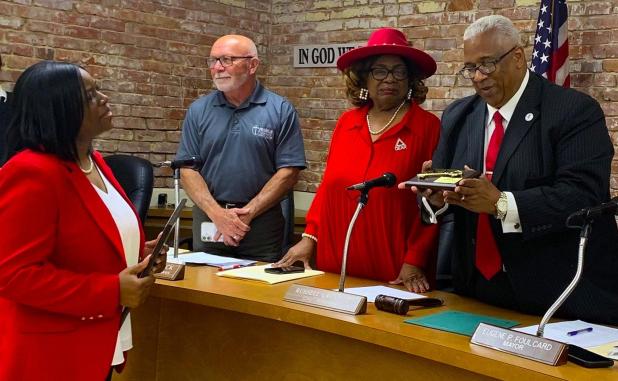
Mayor Eugene Foulcard and the Franklin City Council honored Alexis Rack for her induction into the Louisiana High School Athletic Association's Hall of Fame in Baton Rouge. Alexis was recognized by the LHSAA for her outstanding achievements for her high school, collegiate and professional basketball careers. Her legacy includes numerous records set at Franklin High School and beyond. Alexis was presented with a plaque and a key to the city. Pictured from left above are Alexis, Council Member Chuck Autin, Council Member Pearl Rack and Mayor Foulcard.

Franklin moves ahead with $1.9M water plant rehab

The Franklin City Council voted Tuesday, April 21 to move forward with Phase II of a $1.9 million rehabilitation of the city’s water treatment plant, a project Mayor Eugene P. Foulcard says will deliver the best water quality Franklin has seen in more than 60 years.
Foulcard told the Council Phase II follows a successful Phase I completed in June 2025 and is part of an ongoing effort to modernize a facility that has served the city for six decades. He said the administration will continue seeking additional funding to replace aging distribution lines that in places date back nearly a century.
In other news, the mayor announced that New Orleans Restoration Properties has closed on the old Franklin Foundation Hospital building and will convert it into senior apartments. Foulcard praised the years of community collaboration that brought the project to fruition, naming local agencies, elected officials and neighborhood volunteers who helped shepherd the plan. He said the development will provide safe, modern housing that allows seniors to remain in Franklin.
The Council adopted Ordinance No. 3478, setting the city’s 2026 municipal tax rates, and introduced Ordinance No. 3479, which proposes several amendments to the city subdivision code. The Council also approved a Cooperative Endeavor Agreement authorizing the mayor to work with the Louisiana Department of Veterans Affairs for May 1, 2026–April 30, 2027.
Council members accepted a base bid of $1,964,967 plus alternates from Frisco Industrial Contractors, LLC., for Phase 1B — Treatment Plant Improvements — the action authorizes the mayor to execute the contract. All votes on those measures were unanimous among members present.
The Council also honored Alexis Rack with a proclamation recognizing her 2026 induction into the LHSAA Hall of Fame. She received a plaque and a key to the city and thanked the community for its support.
Mayor Foulcard thanked volunteers from the recent Love the Boot citywide cleanup and urged continued participation in monthly cleanups.

Pages

ST. MARY NOW

Franklin Banner-Tribune
P.O. Box 566, Franklin, LA 70538
Phone: 337-828-3706
Fax: 337-828-2874

Morgan City Review
1014 Front Street, Morgan City, LA 70380
Phone: 985-384-8370
Fax: 985-384-4255