
LSU AgCenter/V. Todd Miller
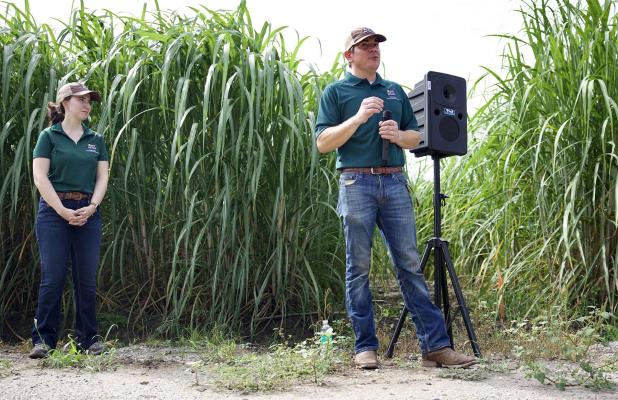
Entomologist Blake Wilson, with sugar cane pest management extension agent Schyler Thibodaux, reports on the danger of the invasive pasture mealybug.
Cane growers hear about new threat
The predictions of a harvest increase over last year’s were undercut by the news of the arrival of a worrisome, invasive insect at the LSU AgCenter’s annual Sugar Research Station field day July 15.
At the outset of the day, AgCenter sugar cane specialist Kenneth Gravois said that the U.S. Department of Agriculture’s National Agriculture Statistics Services is indicating a 5,000-to-6,000-acre increase over last year’s crop, with a clearer focus coming into view in August.
“All in all, I think pretty much we have a big crop, a good crop, and people are excited about it,” Gravois said. “The big thing that is on everybody’s mind is we have to protect what’s out there. And so, with that, I’m sure a lot of people may have already heard about the pasture mealybug.”
For those who haven’t, the invasive pest threatening crops across the South, the pasture mealybug (Heliococcus summervillei), is an insect first detected in the U.S. last year. It travels via wind, storms and unclean mowing equipment. Adults are oval shaped and white and waxy in appearance. They can cause leaf yellowing, which can rapidly progress into crop dieback, thus significantly reducing yields for farmers.
AgCenter entomologist Blake Wilson said the pest has become more widespread in the past few weeks. It is on a destructive path that is likely to continue without proper vigilance.
“I think we’re up to 14 parishes where it’s been detected, including some of the biggest sugar cane-producing parishes like Iberia and Pointe Coupee, but we’ve now started to pick it up in the River Parishes as well,” Wilson said.
While the impact of the pest on crops isn’t entirely clear, Wilson said, observations indicate that even low densities of the insect can produce symptoms.
A few fields where they are present have yellowing of 80% of the canopy.
“This is a very new problem,” Wilson said. “It doesn’t appear the pasture mealybug is a pest of sugar cane in its native Australia, so there’s no playbook to use in response to this.”
One weapon the industry does have to combat the pest is a Section 18, emergency use exemption from federal regulators to use the insecticides Sivanto Prime and Admire Pro to attempt to manage outbreaks.
“Hopefully, those two products together will help growers find some immediate solutions and keep this thing under control before it gets any worse,” Wilson said.
In less troubling news coming out of St. Gabriel, AgCenter researchers from across the scientific spectrum reported on the work they’ve been conducting on behalf of producers over the course of the past year.
Plant pathologist Andre Gama discussed the disease triangle, where for a disease to happen, three things must be in place simultaneously: a susceptible host, a favorable environment and a virulent pathogen.
He said it was harder for weaker stalks with less resilient root systems to defend against soilborne pathogens like the lesion nematode.
“So, they’re going to suffer more by having something feeding off their root system,” he said.
“We are collaborating with physiologists, pathologists and breeders to try and form some sort of solution to this issue.”