
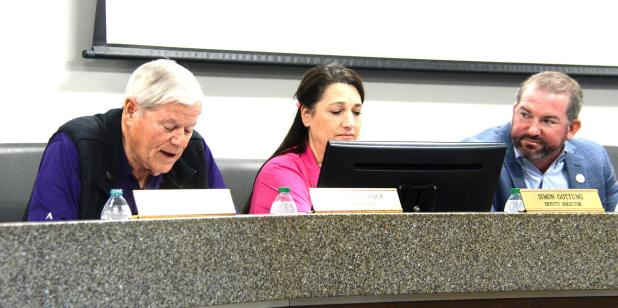
The Morgan City Harbor and Terminal District board on Tuesday appointed Simon Gottung, righht, as the new Port of Morgan City executive director. Gottung succeeds Raymond "Mac" Wade, who has held the job since 2013. Also shown is board member Deborah Garber.
The Review/Bill Decker
Gottung succeeds Wade as port director
The Port of Morgan City has a new executive director.
The Morgan City Harbor and Terminal District board named Simon Gottung to the post at a special meeting Tuesday. Gottung will succeed Raymond “Mac” Wade, who will stay on as an adviser for Gottung’s first months in his new job.
“Simon is the perfect fit,” Wade said in an interview. “I’m leaving it in good shape, and he’s going to take it to the next level.”
The transition comes as the port is poised to play a key role in what some are calling an economic renaissance in St. Mary in which shipbuilding plays a role.
Wade has been executive director since 2013. The board hired Gottung six months ago as deputy director and as an understudy for Wade, who will turn 75 in November.
Wade’s tenure as executive director hasn’t always been easy.
Born to an Air Force family, Wade arrived in Morgan City in 1975 and worked in the oilfield. He and his wife Karen have two grown children and have been married 50 years.
Wade served on the Port of Morgan City board beginning in 1987, and would serve as president and vice president before his appointment as director.
His early years as director were marked by difficulties with sticky “fluff” mud at the lower end of the channel between Morgan City and the Gulf and by a series of floods that deposited silt in what is federally authorized to be a channel 20 feet deep and 400 feet wide.
“We didn’t have a channel,” Wade said Tuesday. “We had to figure out a way to get the channel open.”
One need was to clear the channel of fluff, which can foul ship propulsion systems. Wade went looking for a company to build and operate a dredge that works by agitating water and removing the mud. He found Brice Civil Constructors of Alaska, which built its new agitation dredge at Halimar Shipyard.
The early deployment was marked by a series of breakdowns. But between mechanical problems, the dredge, called the Arulaq, removed the troublesome mud efficiently, Wade said. The U.S. Army Corps of Engineers, originally skeptical about the project, provided funds to keep the program going.
Now the Arulaq operates around the clock, removing fluff at a fraction of the $250,000 daily cost of a cutterhead dredge, Wade said.
But the port had a use for conventional dredges, too. The Corps is in charge of dredging navigable waterways, and Corps funding for dredging was hard to come by – until the last few years.
Now, Wade said, the port is getting $25 million a year for dredging, enough to keep the channel at its authorized depth and width.
“We didn’t get that much money in all the years I was on the board,” Wade said.
He’ll hand off to Gottung, a Northshore native who, like Wade, worked in oilfield-related positions before being hired by the port earlier this year. His wife, Taylor Adams, is from Bayou Vista. They’ve been married 10 years and have three children.
The work at Morgan City’s port occurs alongside developments such as Saronic’s acquisition of the Gulf Craft shipyard and its expansion, and the SpaceX plans for Vermilion Parish, which include a shipping complex.
The health of the channel, plus other projects such as a doubling of the port’s dock capacity, “signifies our resilience on the working coast,” Gottung said after Tuesday’s meeting.
“The thing that encompasses it all is that it allows businesses to scale. The channel allows some of the companies to double down on the size of their vessels.”