
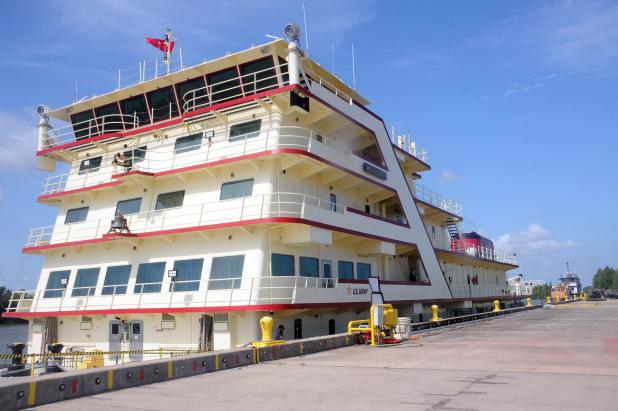
The Review/Bill Decker
The MV Mississippi at the Port of Morgan City dock was the venue Friday for a Mississippi River Commission public hearing.

Col. Scotty Autin, commander of the Army Corps of Engineers New Orleans District, speaks at Friday's public hearing.

Michael Brocato

Raymond 'Mac' Wade
Port successes, flood control, 70-30: River Commission comes to MC
The Mississippi River Commission has spent much of August hearing about the flood control and other needs of people who live in the Mississippi-Atchafalaya watershed. On Friday, it was Morgan City’s turn.
The commission made Morgan City the last stop on its annual “low water” tour of the Mississippi and Atchafalaya basins Thursday and Friday. The five commission members hosted a public hearing at the Port of Morgan City dock aboard the MV Mississippi, the Army Corps of Engineers’ flagship tow vessel.
In a packed meeting room aboard the Mississippi, the commission heard about local successes and local challenges.
Michael Brocato, director of the St. Mary Levee District, repeated the district’s opposition to any change in the congressional mandate that sends 30% of the Mississippi’s water into the Atchafalaya at the Old River structure. Advocates for the Atchafalaya say increasing the flow into the Basin creates flooding risk as well as more sediment that can reduce the depth of important waterways.
“It’s not so much the 30-70,” Brocato said in an interview, “but the Mississippi Sound Coalition wanting to change the operations of the floodway.”
The coalition represents Mississippi interests who feel that, during a series of floods 2016-19, flood control efforts relied too much on the Bonnet Carré Spillway. Bonnet Carré sends water from Lake Pontchartrain into the Mississippi Sound, creating what the coalition describes as damage to the environment and the local economy.
The alternative is greater use of the Morganza Spillway, which would send more water into the Atchafalaya.
“State and federal research dollars should focus on science and engineering to find alternatives that avoid or at least minimize opening the Bonnet Carré Spillway,” according to the Mississippi coalition’s website.
A Lower Mississippi River Comprehensive Management Study is underway.
Brocato called the changing of the flood control operations an “unacceptable risk.”
He also told the commission that infrastructure work is needed for flood protection in the region. He pointed to a pair of flood control gates in the Calumet area that are “past their safe service life.”
And Brocato said that, now that the $80 million Bayou Chene Flood Control Structure is in place to deal with back-flooding in eastern St. Mary, attention should turn to back-flooding in the western parish.
Brocato hopes to see a coalition of Atchafalaya River interests created to look after the needs of the Basin.
Also speaking Friday was Port of Morgan City Executive Director Raymond “Mac” Wade, who hosted a tour of the port Thursday.
Wade told the commissioners that they didn’t see grain silos or cargo containers during their tour.
“But you did see a lot of value,” Wade said.
Recently, Wade has referred often to billions of dollars in products moving through the local waterways.
On Friday, he told the commissioners about work for the U.S. military, liquefied natural gas exporters and even SpaceX.
He talked about companies like Intermoor, Performance Contractors, Conrad Shipyard, New Industries, Halimar and Oceaneering.
The commission’s job is “to develop plans to improve the condition of the Mississippi River, foster navigation, promote commerce, and prevent destructive floods.”
The members are Brig. Gen. Dan Herlihy, Riley James, James A. Reeder, Dr. Robert Miller and Rear Adm. Christiaan van Westendorp.
“Your testimony ensures that any decision by the commission is informed by you,” Reeder told the 21 people who signed up to speak at Friday’s hearing.
Col. Scotty Autin, commander of the Corps of Engineers New Orleans District, drew a line between the flood of 1927 and the increased federal role in river management that was contained in legislation passed the following year.
The 1927 flood caused $1 billion in damage, killed at least 283 people and forced governments to open 154 refugee camps along the river.
The other stops on the low water tour were Caruthersville, Missouri, Memphis, and Vicksburg, Mississippi.