
The Review/John Flores
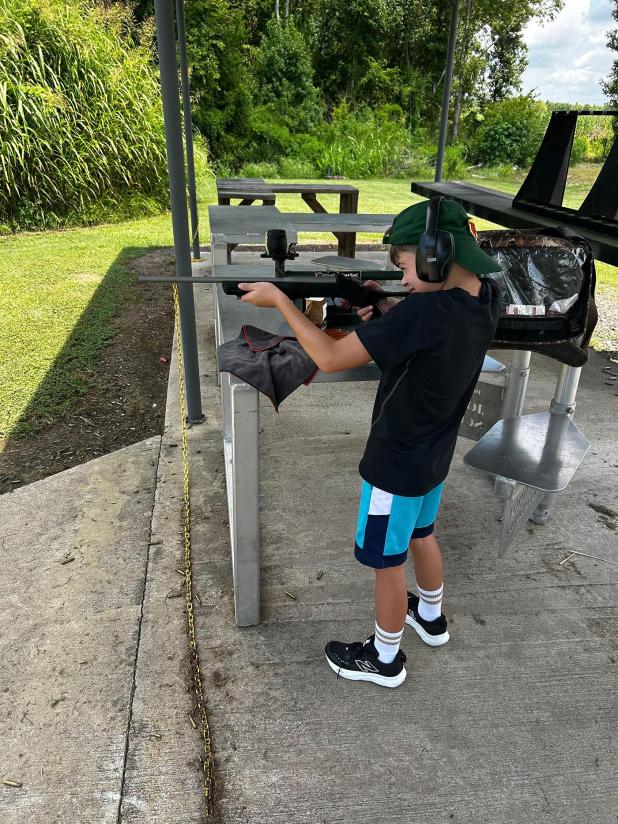
Eli shoots his .410 shotgun at the St. Mary Parish Sheriff’s Office Range.
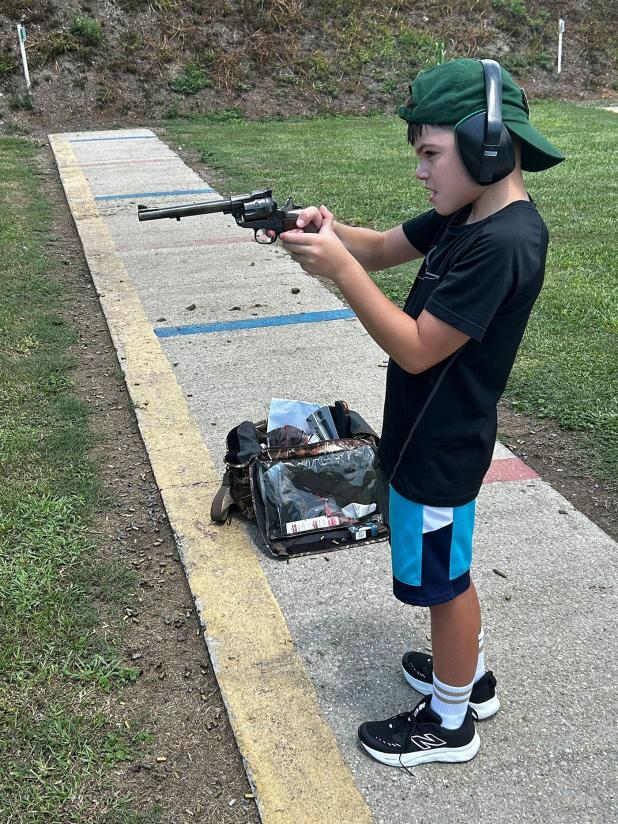
Eli shoots a .22 caliber single action handgun.
John K. Flores: How to teach kids at the shooting range
A number of years ago, I took my grandson Gabriel, now 25, to the St. Mary Parish Sheriff’s Department shooting range. More specifically, it was a Saturday in August. The time of year when kids go back to school and are signing up for activities like 4-H.
Gabriel was a little fella, but at 10 years old had a lot of heart and wanted to be a hunter like his dad and grandfather.
The range was fairly busy as you would expect for a Saturday, with some guys sighting in hunting rifles and others simply making those small tweaks to their scopes.
I brought a youth model 20 gauge shotgun for Gabriel, as this would be the firearm he’d hunt squirrels and ducks with come fall. We went over all of the shotgun’s safety features, along with proper handling, courtesy to other shooters, and respect for firearms in general.
We also talked about the shotgun’s recoil, or “kick.” How a gun kicks is always in the mind of youngsters. Trust me, I have nine grandchildren and eight of them are boys. It’s amazing to me how my older grands, even though they never fired a gun before, all asked, “Is it going to kick?”
I mean, is it normal classroom or recess talk?
When it was time for Gabe to shoot, I set up a zombie splatter target, hoping to make it fun. He loaded the gun under my supervision and did all of the safety things required. Finally, he shot and by the looks of the target all was good, except for one thing. There was a small single tear in the corner of his eye.
“What’s the matter buddy?” I inquired.
That’s when Gabe said, “It hurt my shoulder.”
The little 20 gauge was still a little too much for a boy his size.
Thank God, local Attorney Robert Duffy was there. He was sighting in one of his rifles and came up to me and offered the use of a small .22 caliber rifle to finish Gabriel’s shooting session. The last thing you want, where youngsters are concerned, is a lasting bad experience.
Gabriel did well that day and joined the St. Mary Parish 4-H shooting team that fall. And today, as a man in his own right, loves to hunt when he is able.
This past week I had the pleasure of taking another grandson, Eli, shooting. This time we were using a small youth model .410 gauge shotgun I bought him. I also purchased the small 2-1/2 inch .410 loads with the goal of super low “kick.” I also brought a western style .22 caliber single action pistol to entice his interest.
Call it lessons learned on my part. For some reason my three sons breezed through the father and son rituals of learning to shoot. Maybe I was younger and more into, “suck it up, buttercup,” when it came to them rubbing their shoulders.
My best friend and his son grew up with my two youngest sons. Whenever his son came to him whimpering with a minor scratch or small injury he’d say, “Son, how far is that from your heart? You’ll be OK.”
Invariably, the lad would run off as if there were magic healing in the words of his father. I have to say, I tried those very words and lo and behold, they worked in most non-life-threatening issues from skinned knees to being hit with a bad hop baseball.
That said, when your young shooters are growing up there are things to consider when teaching them to shoot. The first is their physical size, including their hands. Most firearms today are fitted for adults.
Oh sure, there are youth shotguns, but even those, in most cases, would have to have the stock refitted for children. Trust me, my wife has a Remington 20 gauge youth model pump gun in my gun vault that fits her perfectly, but is too big for most 9- and 10-year-olds. Try starting them out with youth model .410 shotguns and youth model .22 rifles.
Second, is their physical strength. Even though there are youth model firearms, it doesn’t mean they are light weight or the mechanics are youth friendly. The .410 Eli shoots is a Braztech International youth shotgun with a pistol grip and a short 16” barrel. The stock is manufactured for smaller children.
However, the breech is hard for him to open and load, and the safety is even harder to switch off and on. So, it’s important to consider size and strength of youth when teaching them to use firearms.
Another consideration is to take your time. One session at the range does not make a marksman. No child gets to start playing shortstop on their Dixie Youth team without getting groundball reps at multiple practices. Why would firearms be any different?
Be realistic when it comes to a successful day at the range. The focus initially shouldn’t be on hitting the bullseye, but rather did he or she do everything safely.
Was the direction of the gun always pointed up or down when not firing? Was the safety on at all times? Were the youth aware of other shooters down range changing targets?
I told Eli, who is 10, once a bullet or shotgun pellets leave the barrel there’s no bringing them back. They are going in the direction fired. So, we have to do everything safely “every time!”
Besides loading and unloading, I also spent time showing and teaching Eli each component of the firearm. We called them by their names. The butt stock. The forestock/grip. The hammer. The firing pin. The trigger. The cylinder and barrel. All were orally tested while we conducted our shooting session.
With hunting season just around the corner, it’s important to get your youth to the range and start going over those fundamentals again. So, when is the right time to start teaching your kids gun safety? How about when they get their first squirt gun or nerf gun? In the Flores house, the rules still apply whether a toy or the real thing.
Between now and early fall, the Sheriff’s range will get busier and busier. Where youth are concerned, it’s shooting time — or not!
John Flores is the Morgan City Review’s outdoor writer. He can be contacted at gowiththeflo@cox.net.