

Photos courtesy of Greig Chauvin
The Liberty Bell visited Morgan City by rail in 1915 on its way to the Panama-Pacific International Exposition in San Francisco. The photos with this story have been colorized.

Morgan City residents celebrated the end of World War I by parading with this enormous American flag banner, created by Charles Sumner Gray.

Mayor M.D. Shannon declared a holiday to celebrate the end of World War II. Morgan City businesses closed at noon, and a parade marked the occasion.
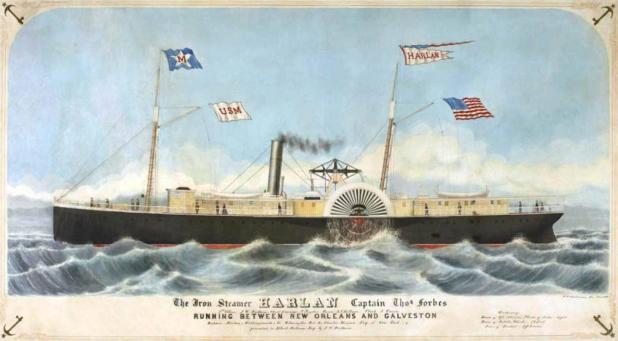
Former President Ulysses S. Grant came to Morgan City on this steamship, the Harlan, owned by the city’s namesake, Charles Morgan.
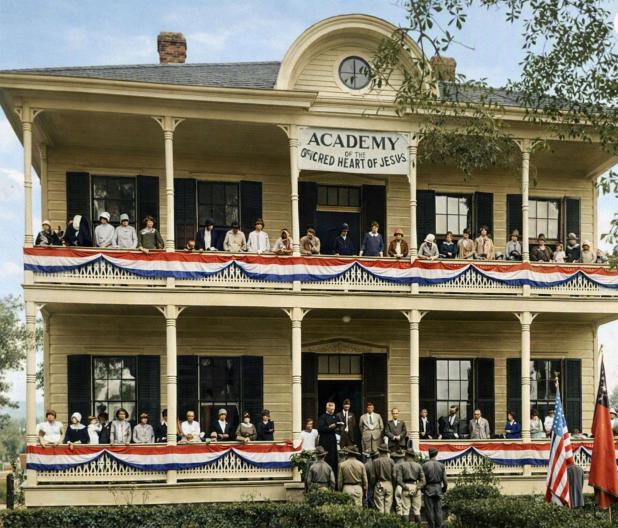
Sacred Heart Academy welcome home servicemen at the end of World War I.
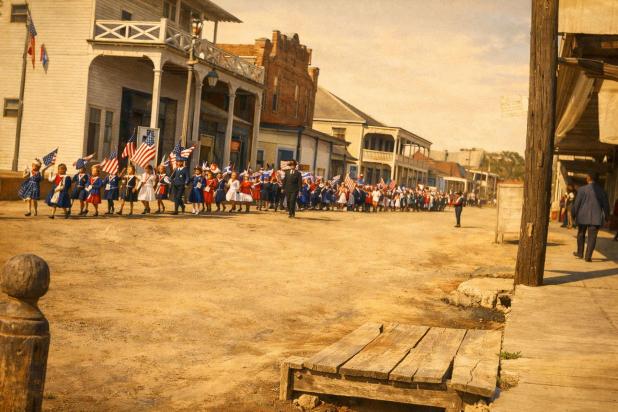
Morgan City children marched through the streets carrying flags to view the Liberty Bell and, along with 5,000 residents, sang “America the Beautiful” as it passed through.
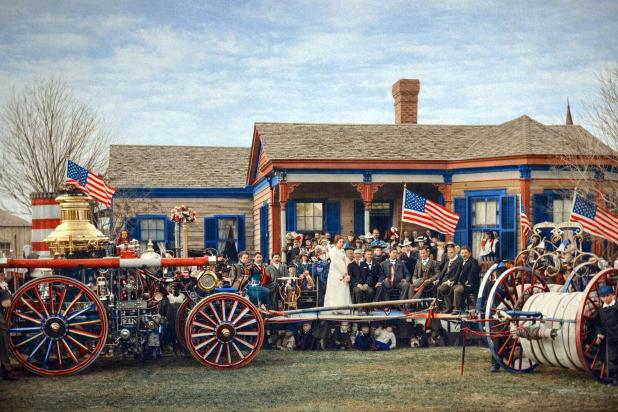
This photo of Berenice, Morgan City’s second fire engine, shows the city’s patriotic spirit.
Morgan City celebrates America: A look back at patriotic celebrations
In commemoration of our nation’s 250th birthday, we look back at some of the moments when the citizens of Morgan City demonstrated their patriotism and loyalty to the United States.
Although Morgan City did not exist when our nation was founded, our community has played a part in our country’s narrative.
During the 1880s, former president Ulysses S. Grant embarked on a journey across the United States. Grant had been instrumental in sending Union troops to Brashear very early in the Civil War because he understood Brashear’s strategic importance to the nation.
Grant took the trip to promote economic development. He traveled through Morgan City to highlight the region’s resources and its importance to trade and transportation along the Gulf Coast.
Because Charles Morgan, our city’s namesake, owned shipping and rail lines, the trip also showcased Morgan’s cross-country transportation system.
Grant boarded the Harlan, a Morgan line steamship, and traveled by water to Morgan City.
There, he disembarked from the ship to board a Morgan Line railroad train to travel to the West Bank in New Orleans. Upon exiting his rail car, he would have boarded the Morgan Line Ferry that crossed the Mississippi River to arrive at Morgan’s Elysian Fields’ dock.
In 1915, the Liberty Bell also traveled by rail from its home in Philadelphia across the country. The bell was considered a symbol of patriotism by many Americans but it was not until this trip that it became the world’s most famous symbol of liberty.
The trip came about as a result of 500,000 U.S. school children signing a petition asking Philadelphia to send it to the Panama-Pacific International Exposition in San Francisco, and political leaders wanting to increase public support for the possibility of the upcoming war.
The bell thus began its one and only tour of the nation. An all-steel flatcar was constructed. There was a generator onboard that shown a light on the bell through the nights when the bell stopped in cities across the United States.
There was a brass railing that served as a barrier to onlookers, and only the blind were allowed to touch the bell. However, the guards often allowed babies, toddlers, and others beyond the railing to touch or kiss the relic.
The bell did not officially stop in Morgan City, but it paused briefly as it traveled through, and a delegation from the Ladies Civic League under Mrs. John Cotten placed a wreath on the car.
The school children of Morgan City also marched through the streets carrying flags to view the bell and, along with 5,000 residents, sang “America the Beautiful” as it passed through. Thirteen guns were fired as the train rolled into the station.
The patriotism and heroism of the young men from Morgan City who fought and died overseas in the World Wars are well documented. However, local citizens know little of the contributions made by our citizens of color.
In April 1917, the Morgan City Review writes that many local African American men eagerly applied to join the Army of the United States to fight in World War I. Five hundred people thronged the station platform to give a farewell to the patriotic men of color who offered their services to the nation and their flag.
Morgan City’s residents of color organized into patriotic committees to support the war. A colored unit of the Woman’s Committee of National Defense was formed. These women joined to help win a world war for democracy.
Morgan City’s residents of color formed an auxiliary unit of the American Red Cross, and there were more members of the Colored Red Cross in Morgan City than in any city of its size in the state!
At the end of World War I, celebrations occurred throughout the city. A parade was held in which a gigantic American flag was unfurled and carried through the streets of Morgan City.
The enormous banner was painted by local artist Charles Sumner Gray and is pictured on Railroad Avenue between First and Second streets.
A photo of the banner shows the Gathright Building to the left, and one of Morgan City’s old train stations is pictured along the railroad tracks. If you look very closely, Sacred Heart Church is in the background, and its clock tower had not yet been constructed.
In 1942, 75 local men of color showed their patriotism by attending a Civilian Defense Training School to become members of the Citizens Defense Corps. Their courses included: High Explosive Bombs and Fire Defense, Care and Storage of Gas Masks, First Aid for Chemical Casualties, and Emergency Medical Service. They were trained to become auxiliary firemen, auxiliary police, air wardens, fire watchers, and emergency medical servicemen.
The two-week course also taught types of war gases, espionage and sabotage, warning of military aircraft, and service in the civilian air raid warning system.
Upon the return of our servicemen following the end of World War II, another large parade was given to honor their sacrifice for our country. Mayor M.D. Shannon declared it a holiday and asked every business to close at noon and come to cheer on the veterans who marched in the parade.
There are other beautiful photographs that indicate our community’s great patriotism such as a colorized picture of the 1901 Berenice, Morgan City’s second fire engine.
The Sacred Heart Academy in 1918 celebrated the return of soldiers who served in World War I.
If any of these stories are of interest to you, come by the new location of the Morgan City Archives at 506 First St. during the Louisiana Shrimp & Petroleum Festival and take a closer look at the rich history of Morgan City. The archives will be open from 1-5 p.m. on Thursday, Sept. 3; 10 a.m.-3 p.m. on Friday and Saturday, Sept. 4 and 5; and Monday, Sept. 7 from 10 a.m.-3 p.m.