
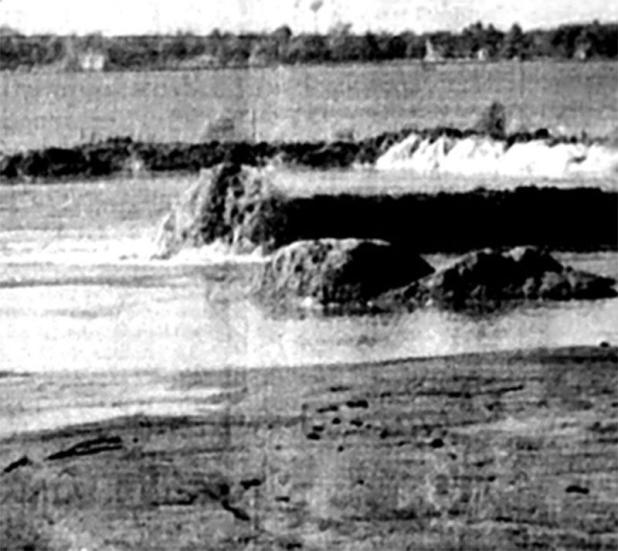
Morgan City Review photo
Daily Review, July 2002. “Final Phase Begins” — the second round of sediment pumping operations at the Lake End Park beach front, using sand dredged from Berwick Bay more than a mile away.
Before the land bridge, there was Lake End Park
Submitted by
Catherine Holcomb
Long before Louisiana formally adopted a 94-mile coastal “land bridge” strategy this month, St. Mary Parish was already proving the concept works.
A review of Daily Review archives stretching back to 1968 documents more than half a century of beneficial-use-of-dredged-sediment projects at Lake End Park on Lake Palourde — work that built a public beach, stabilized shoreline, and ultimately created the foundation for one of the most-used recreational facilities on the Cajun Coast.
The story now offers a striking parallel to the Coastal Protection and Restoration Authority’s newly announced commitment to use beneficial dredged material as the backbone of coastal restoration across South Louisiana.
A 1968 vision
The earliest documented chapter begins on September 5, 1968, when Morgan City Councilman Frank Domino, chairman of the committee for an improved Lake Palourde Park, told members at a special session that approximately 47,000 cubic yards of lake material would be dredged to deepen and improve the beach area. Low areas in the parking section and beach would be backfilled with the dredged material, and the beach area would then receive a ten-inch blanket of sand.
The estimated cost of that early vision: $367,500.
It was, in essence, beneficial use of dredged sediment — decades before the term entered the coastal restoration lexicon.
The 2002–2004 Shoreline Stabilization Project
Three and a half decades later, the U.S. Army Corps of Engineers launched what became a $4.7 million shoreline stabilization project that fundamentally reshaped the Lake Palourde shoreline along La. 70.
In July 2002, the second phase of a dual dredge-and-pump operation began, with Mike Hooks Dredging Co. of Lake Charles awarded a $3.4 million contract for the second phase alone. The dredge worked Berwick Bay more than a mile away, pumping sediment through pipeline to the lakefront.
Project Manager Frank Duarte of the Corps told the Daily Review that the work would place a layer of top-quality sand over the base of inferior sediment and vegetation already in place. “It appears we’ll have an ample volume of good sediment to finish the project,” Duarte said.
By August 2003, more than 480,000 cubic yards of top-grade sand had been pumped from Berwick Bay. Falcolm Hull, chief of the Corps’ project management western branch, told the Daily Review the project would come in well under budget.
The Daily Review captured the scale of the work in a September 2003 photograph showing contractors smoothing and sloping sand on the freshly built shoreline.
By September 2004, a Daily Review feature headlined “MC lakefront park a work in progress” celebrated the completed beach with a photo captioned “Sandy Beach, Shallow Lake — Perfect Combination.”
The Corps project did more than build a beach. It created new lakefront shoreline along the northern edge of Lake Palourde — newfound land that doubled as a shoreline stabilization project, exactly the kind of dual-purpose infrastructure now central to CPRA’s land bridge strategy.
More than two decades earlier, Morgan City had quietly demonstrated exactly that principle on the shores of Lake Palourde.
The Katrina
chapter
What happened next is a chapter of St. Mary Parish’s history that deserves to be told more often.
When families fled New Orleans after Hurricane Katrina struck in August 2005, many came through St. Mary Parish. The newly created shoreline at Lake End Parkway — land that did not exist five years earlier — was turned into a Federal Emergency Management Agency park for evacuees.
FEMA contracted with the city of Morgan City to use the property. Federal money built roads, installed utilities, and placed camper trailers on the exact footprint that had been envisioned by the city for camper space expansion. FEMA’s participation enabled the initial development of Lake End Parkway to be realized much sooner than anticipated, the Daily Review reported in August 2008.
When the FEMA lease expired in July 2007 and the city retook possession of the property, what had been emergency housing for displaced Louisianans became the foundation for an expanded public park. By 2008, the park had grown to 122-plus camping slots at the adjacent Lake End Parkway. By September 2009, the Daily Review reported that Lake End Park “continues to grow and improve” with new boat launches, beach areas, picnic facilities, and infrastructure built on the FEMA foundation.
St. Mary Parish offered ground for displaced families when they needed somewhere to land — on land that had been built with dredged sediment from Berwick Bay only two years earlier.
The connection
to the land bridge
Louisiana’s commitment this month to a 94-mile land bridge strategy under CPRA leadership is built on a simple proposition: Sediment dredged from navigation channels and waterways should be put to work building land rather than disposed of as waste. Beneficial use of dredged material, long advocated by St. Mary Parish leaders including CPRA Board Member Bill Hidalgo, is now the centerpiece of state coastal policy.
Lake End Park is one of the longest-running, best-documented local examples of that principle at work.
From a councilman’s 1968 vision, to a Corps of Engineers shoreline stabilization project, to emergency housing for hurricane evacuees, to today’s regional recreational destination — every chapter was built on dredged sediment pumped through pipeline from a nearby waterway.
It is the same fundamental concept that will now guide the protection of communities across coastal Louisiana.
What comes next: the Atchafalaya River Coastal Hub
As St. Mary Excel continues its work on the Atchafalaya River Coastal Hub (ARCH) — a $12.75 million coastal resilience facility planned for the Morgan City riverfront — the lessons of Lake End Park remain instructive. The same partnerships of city, parish, state, and federal agencies; the same engineering principles; and the same beneficial-use philosophy that built a beach in 1968 and a refuge in 2005 will define the next generation of coastal infrastructure in St. Mary Parish.
The land bridge is not a new idea in Morgan City.
It is the next chapter of work St. Mary Parish has been doing since 1968.
The sources for this story inclue: Historical reporting: The Daily Review, Morgan City — Sept. 5, 1968; July 11, 2002; Aug. 28, 2002;
August 15, 2003; September 11, 2003; November 14, 2003; September 3, 2004; August 29, 2008; September 4, 2009.
Modern quotes: CPRA press releases; The Advocate (December 2025); NOLA.com (April 2026); coastal.la.gov (2025–2026).