
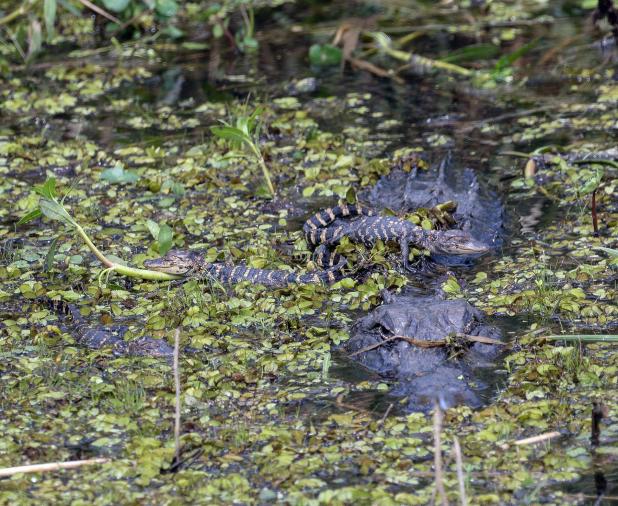
A female alligator protecting and keeping watch over her young.
The Review/John K. Flores
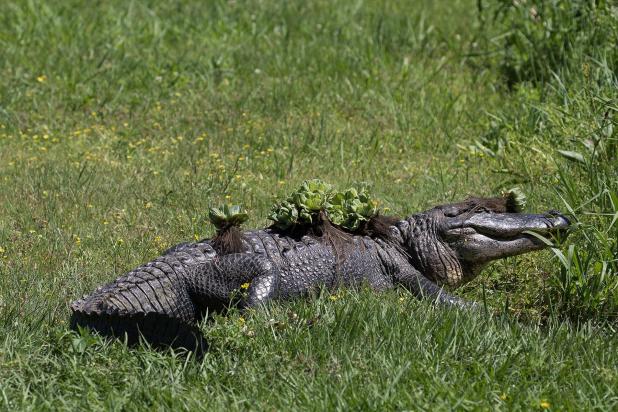
Alligators have become a nuisance in some areas where they are found in subdivisions, particularly where residents have ponds.

Christine Flores and a boat-load of alligators from a commercial harvest, waiting offloading.
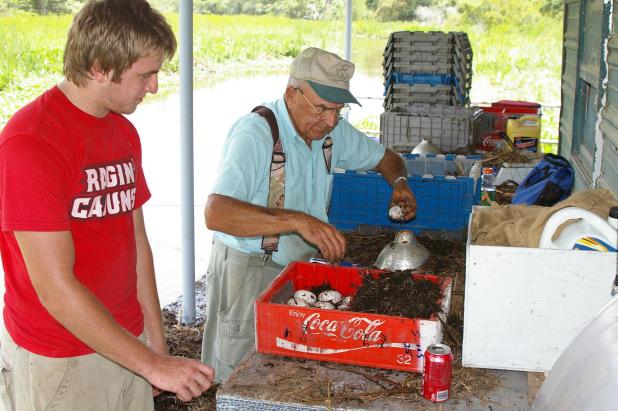
A farmer candles alligator eggs to ensure their viability.

Alligator hides can be utilized for all sorts of luxury leather products.
John K. Flores: Will new recreational season reduce gator population?
By JOHN K. FLORES
When I first arrived in Louisiana back in 1984, one of the first outdoor activities I participated in was alligator hunting. My father-in-law held 17 private land tags at the time for a then-recovering population and I accompanied him as his helper.
While running lines he told me story after story how for years he unknowingly contributed to the alligator’s demise saying, “John, I believe we’d have killed the last one. Sometimes, we’d run all night just to catch a four-footer to sell without seeing any others.”
When the alligator was placed on the endangered species list in 1967, its population was estimated at less than 100,000 throughout its entire southeastern United States range that includes Alabama, Arkansas, Florida, Georgia, Louisiana, Mississippi, North Carolina, Oklahoma, South Carolina and Texas.
The current “wild population” today, a half century later, is estimated at 2 million alligators, with another 1 million on farms. The alligator population has recovered so much so that, in many cases, they have become a nuisance.
I can vouch. Last summer my neighbor called the local nuisance alligator hunter, of which there are 65 licensed officers throughout the state that handle more than 2,200 calls on the average per year, to come and remove a 7-footer from their yard where it was sunning itself.
The couple had small children who played in the yard, so obviously there was reason to be concerned.
In my own yard, also last summer, I had a small 3-foot alligator resting in the shade beside my boat shed. I spotted it while mowing the lawn. I left it alone and the next day it was gone.
The alligator has been removed from the Endangered Species List since 1987. Since delisting, of the 10 states in the Southeast, nine hold special alligator seasons, and only one of those states, Louisiana, is currently based on commercial harvest and not recreational/sport hunting.
It is estimated that 79% of Louisiana state lands are private and the remaining 21% public. The commercial wild alligator program, according to Louisiana Department of Wildlife and Fisheries Alligator Management Program 2024-25 Report, showed how 42,035 tags issued to 4,305 hunters, garnered some $3.1 million for hides and another $5.4 million for meat.
Also in 2024, harvested wild alligators averaged 7.7 feet in length and sold for an average of $12 per foot. What’s more, as a side note, in 2024, 55 licensed alligator farmers statewide held inventories of well over a half million alligators valued at some $62.7 million.
Alligator farmers obtain their inventories from egg collection on mainly private lands. In 2024, there were an estimated 52,420 nests across the survey range. A nest can contain anywhere from 20 to 50 eggs with nests averaging 32-36. Those eggs are subsequently sold to alligator farmers for $15-$20 each, depending on market fluctuations and inventories.
In 2024 there were 300,483 eggs collected. With a hatch rate of 87.4%, it was reported 262,586 of those eggs hatched, where 15,994 were returned to the wild, or roughly 5%.
I can remember helping my father-in-law release farm alligators. In those years, nearly two decades ago, our percentage of farm alligators released back into the wild was something like 17%. In subsequent years it dropped to 12%.
The LDWF does facilitate and manage an Alligator Harvest Program for the general public, where Louisiana residents can apply for over 1,000 lottery permits to harvest over 3,000 alligators on 51 designated wildlife areas managed by the state.
This lottery program runs concurrent with the commercial wild harvest program practices, where applicants pay a $5 application fee, a $25 license fee, and a $40 per tag fee (total 3) that allows them to sell their alligators if they so choose.
All other commercial wild alligator hunting activities on public lands and lakes, both state and federal, operate on bidding and lottery processes.
This will now change as the LDWF has issued a Notice of Intent on May 7, 2026, to hold a recreational lottery alligator season starting Oct. 1 and running through Oct. 31.
The efficacy of the recent LDWF NOI began in 2023 with the State Legislatures House Concurrent Resolution 132 to complete a market analysis and hunting study. Bullet points included the wild alligator population growth, nuisance hunting, markets, and modifying the tag per acre issuance formula.
Senate Bill 229 in 2024 focused on reducing return of alligators to the wild and placing caps on size, with responsibility to the special permit egg-collection holder and landowner.
Senate resolution 105 pointed out the need to make recommendations regarding the management of all alligator populations. SB 244 authorized the special recreational season (R.S. 56:256) and House Bill 767 (R.S. 56:268 & 3002) created the lottery, license fees, and revenue deposit.
Most of the May 7 LDWF NOI focuses on the who, what, where, when, and how rules of the recreational alligator lottery hunt. Recreational hunters, for instance, will not be allowed to sell hides, meat, or parts of their alligators.
Additionally, Louisiana residents who participate must be 16 or older and will be provided 2 tags if successful in drawing out. Lottery applicants will be charged a “non-refundable” $50 application fee and required to purchase a $25 alligator hunters license and required to have a basic residence hunting license.
Through the recreational hunt, will adding 10,000 wild harvest alligator tags, essentially less than 1 percent, make a difference in helping curtail a growing population? Will reducing the percentage of farm alligators back into the wild slow the growth of the population?
I’ve personally commercially hunted alligators and after filling out the LDWF allotted tags for the property gone teal hunting a week later. With all the red eyes I saw with my headlight in the dark on my way to the blind, I came to realize we didn’t put a dent in the population.
I’ve also released hundreds of alligators by the semi-truck full. I understood the numbers we released at that time reflected what biologists felt would survive the nest to reach the 3-foot range. However, the toe tags we recovered from harvested released alligators year after year were always less than a couple percent of the total tags issued for the property.
No doubt the new recreational season is great for Louisiana sportsmen who have been clamoring for an opportunity to hunt gators for years. Moreover, the inaugural season is probably a good first step in shaking the bugs out for subsequent recreational seasons.
Success will depend a lot on private property access, which creates a whole batch of additional concerns such as trespassing, fear of property damage, and insurance requirements for large land holders/corporations.
The public comment period runs through June 26. Those wishing to make a comment concerning the upcoming recreation alligator season can email them to LDWF Alligator Program Manager, Jeb Linscombe, at jlinscombe@wlf.la.gov.
John K. Flores is the Morgan City Review’s outdoor writer. He can be contacted at gowiththeflo@cox.net.