
The Review/John K. Flores
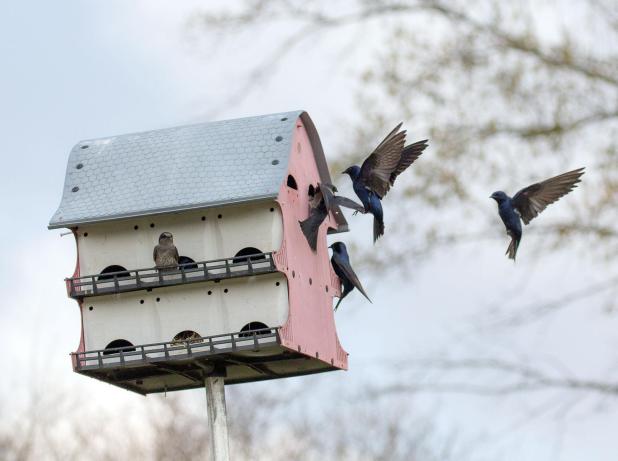
These purple martins arrived at the end of February

Purple martins make their summer home selection.
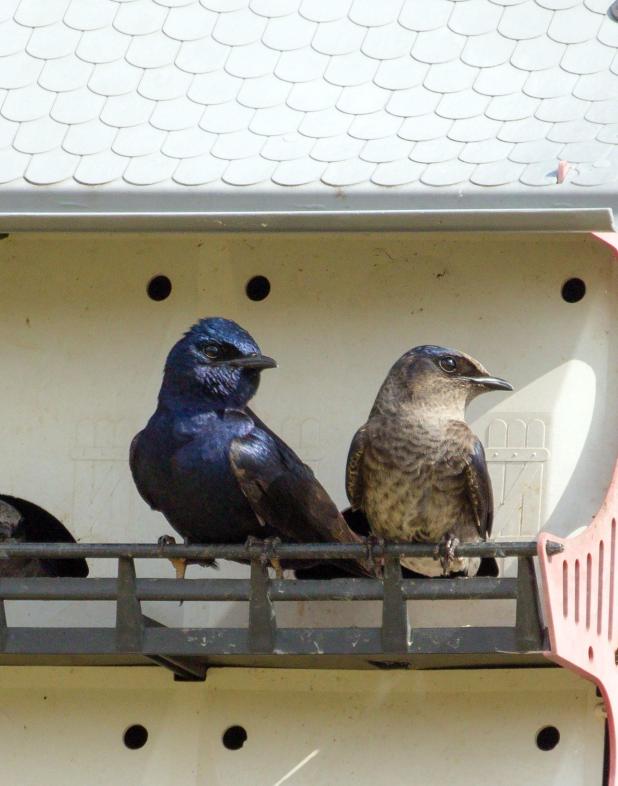
A male and female purple martin guard the entrance of their summer residence.

Purple martins check the available space in their summer home
John K. Flores: The purple martins are back
This past week, my wife and I were working in the garden when the cheery sounds of purple martins seemingly came out of nowhere.
“They’re baaaccckkk!” I said to her.
Christine and I have come to enjoy this annual arrival and the subsequent spring and summer months they spend with us raising and fledging chicks.
Suddenly, Christine called out to me, “Honey-honey quick! Come put the martin house up.”
It was one of those “oops” moments. After the martins left late last summer, we took the two houses down to clean and store for the winter. The martins literally had keyed in on the exact spot where they nested in our yard last year and were flying in acrobatic circles around us, as we scrambled to put the house up.
No sooner had we walked away, when several martins immediately took up occupancy, making themselves at home.
Delaina LeBlanc, Biological Resources Coordinator for the Barataria-Terrebonne National Estuary Program, monitors several colonies of purple martins in the estuary that includes New Roads, Plaquemine, Thibodaux, Cocodrie and Grand Isle.
LeBlanc said, “Last year I banded 13 adult birds with alphanumeric bands that, if photographed or viewed through a spotting scope, could be read under the right circumstances. One of the birds I banded at my home, a female, has returned. What this tells us is that she survived to breed another year.
“She was an adult when she was banded last year,” LeBlanc continued, “so we don’t know her exact age, but we can age her from last year and track what gourd she nests in, how many eggs she lays, how many successfully hatch, and how many chicks successfully fledge.”
Purple martins are the largest swallow species in North America. They are agile acrobatic aerial insectivores that consume hundreds of insects daily that include beetles, caddis flies, crane flies, crickets, dragonflies, grasshoppers, mosquitoes, moths, paper wasps and stone flies.
According to George H. Lowery Jr., author of Louisiana Birds, the purple martin is the earliest bird to return to Louisiana after wintering south of the Gulf.
Lowery says in the southern region of the state, martins are most always back by the first week of February with nest box selection taking place immediately. Actual nesting takes place in April.
LeBlanc said, “Monitoring colonies provides valuable information on breeding success. While this species is not considered a ‘conservation concern,’ it relies heavily on humans.
Their populations have declined by about one-third over the past 50 years due to competition with introduced invasive species of European starlings and house sparrows for housing, and reduced food sources resulting from increased pesticide use.”
Purple martins are gregarious birds and prefer multi-compartment houses.
Moreover, Lowery notes that Native Americans were fond of martins and would use hollowed-out gourds on poles for them to nest in.
Today, there are poles with plastic gourds that can be purchased on Amazon and put up to mimic some of those ancient purple martin residences.
Martin houses should be at least 10 to 15 feet above ground. Additionally, try to keep them out in the open and away from trees and outbuildings where raptors, cats, raccoons and other predators can’t depredate nests.
Christine and my nest houses are right in the middle of that range extending roughly 13 feet above the ground.
Over the years they have returned and seem quite happy with our arrangement as they circle and glide into the residence, diving in and out of the entrance holes.
Finally, purple martins typically lay 3 to 5 eggs that on the average incubate in 13 days. Afterwards, young remain in the nest some 4 to 5 weeks before fledging.
The only thing that’s difficult to watch is the constant battles between the martins, sparrows and starlings.
The purple martins annually hold their own, where they typically occupy 60% of the holes.
However, it’s not unusual for us to find a dead martin or sparrow chick on the ground from time to time.
The peak of the purple martin migration is a few weeks away and there is still time to put up a purple martin house.
There’s nothing quite like the color purple arriving each spring. Why not make your yard an oasis for them?
John Flores is the Morgan City Review’s outdoor writer. He can be contacted at gowiththeflo@cox.net.