
LSU AgCenter/Olivia McClure
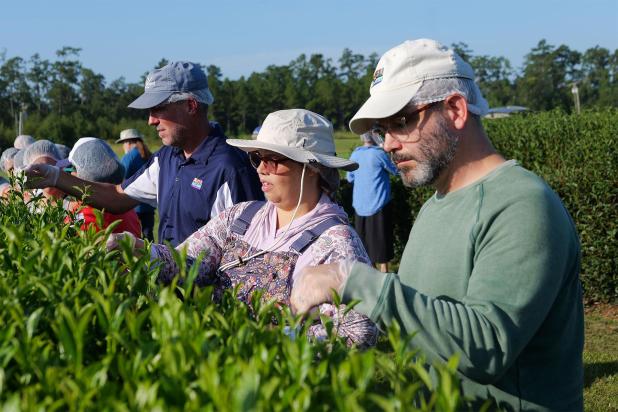
Participants in a workshop held Aug. 21 at the LSU AgCenter Hammond Research Station pluck leaves from tea plants.
Tea time? Workshop explores production in Louisiana
On a recent Friday at the LSU AgCenter Hammond Research Station, an aroma reminiscent of freshly cut grass filled a meeting room. Participants in a workshop on tea production had returned from a field outside where they’d plucked tender leaves earlier in the morning and were now learning the art of transforming them into tea.
Yan Chen, an AgCenter horticulture professor, showed the students how to move their hands in a rolling motion as they massaged piles of tea leaves on mats — a process that breaks down cell walls, releasing flavors and fragrances before the leaves are dried for storage.
After several minutes of rolling, the grassy odor softened, and Chen encouraged the group to try to pick up on scent notes like vanilla. The changes in aroma are subtle but become easier to detect with experience.
Attendees of the event, held Aug. 21, were eager to learn about these sorts of quirks of tea production. Most are new to growing tea or are considering planting it, making them part of a trend of heightened curiosity about the industry.
“We do see really high interest from prospective growers,” Chen said.
There are just a handful of commercial tea growers in Louisiana and the South. The crop, however, is well suited to the region. Native to southeast Asia, tea plants (Camellia sinensis) are closely related to the familiar camellia shrubs (Camellia japonica and Camellia sasanqua) that Louisianans prize for their colorful winter flowers.
“Tea is very adaptable to different soil types as long as the pH is in the range of 5 to 5.5,” Chen said. “Here in southeast Louisiana, we have that pH in most of our soils. Pretty much wherever you can grow camellias, gardenias and blueberries, you can grow tea.”
Tea has been grown for hundreds and even thousands of years in China, Japan, India, Sri Lanka and a few African countries. These places continue to be the world’s top producers and exporters of tea, a commodity that has long been in high demand in Western countries — including the United States, where tea consumption has surged in recent years.
Americans spent $13.9 billion on tea in 2025, with the premium specialty tea segment capturing $3.5 billion of that market, Chen said.
There are about 60 tea growers, many of them small-scale operations, in the U.S. mainland and several more in Hawaii. Domestic tea production is gradually increasing, especially among specialty crop, vegetable and citrus growers looking to add a low-maintenance, perennial crop to their production systems.
Tea plants are long-lived; depending on whether they are propagated from seeds or cuttings, they can be productive for 50 to 75 years. They have few disease and insect problems in Louisiana.
Breaking into the tea business isn’t as simple as it may seem, though.
“Tea is not a crop that a lot of people feel comfortable growing,” Chen said. “Growing tea is easy, but processing tea and branding it and making your tea stand out is challenging.”
Patience is key to growing and processing this crop. Plants need at least four years in the ground before they form a “plucking table” that provides enough leaves for harvesting. And while there are mechanical tea harvesters, many producers opt for more labor-intensive methods.
Tea plants are periodically trimmed to promote a new flush of tender growth, and only leaves from the very tip of each stem are plucked. As the workshop participants discovered in the morning sun at the Hammond Research Station, it takes time — especially for inexperienced pluckers — to gather any significant quantity of leaves.
Chen’s team is proposing a multi-institution project to develop an AI-driven, sensor-guided precision harvester that mimics delicate hand-plucking movements to reduce labor costs while protecting leaf quality.
Making tea is a laborious, almost artistic process, too.
Green and white teas are made from the same plants as black tea, but they are processed differently. Tea makers must pay close attention to the slight shifts in appearance, feel and smell that happen when rolling and drying leaves to get the results they — and their customers — want.
“You have to make sure you know the processing steps, you know the cues,” Chen said. “The fragrance changes over time when you go through different steps of tea making, and you know when you get to the next step.”
“We’re trying to make it more scientific, to define each of the steps for processing tea more scientifically instead of just artistically by tea masters,” she continued. “Instead of judgment by individuals, we’re trying to make it scientific.”
Chen has been studying tea for about a decade, with the first tea plants being installed at the research station in 2016. Her work, along with the workshop, is supported by a U.S. Department of Agriculture specialty crop block grant.
“It’s been very rewarding learning about tea, and I love this plant so much,” she said.
After a lunch break, the workshop group drove north of the station to Fleur De Lis Tea Co. in Amite. There, they met with founder David Barron, who recounted how he expanded from growing tea as a novelty to selling it commercially and opening an event venue on the farm’s grounds.
Barron didn’t know anything about tea plants when he got his start in 2017. A nursery owner with whom he’d struck up a friendship after meeting at a tire repair shop offered him some leftover plants — including 1,000 Camellia sinensis shrubs. Intrigued, Barron picked them up and decided to plant them among the pine trees on his property.
Barron then had to learn the ropes of harvesting, processing and marketing tea. With help from Jason McDonald, of The Great Mississippi Tea Co., and others in the close-knit tea industry, Barron got his brand off the ground — and people loved the taste and aroma of his products.
Today, Barron supplies tea to Harney and Sons, a major tea importer, and sells locally and online. His popular Big Easy black tea, which has notes of honeysuckle, placed second in its category at The Leafies international tea contest in London in 2022.
“We were amazed,” Barron said. “It proves that tea can be grown in Louisiana, and it can be award-winning tea sought after all around the world.”