
LSU AgCenter
Voracious insects can damage camellia leaves, creating yellow spots and possibly preventing the plant from blooming.
Get It Growing: How to fight leaf scale on camellia japonica
Your camellia has yellow blotches on its leaves and seems to be struggling. Aren’t these flowering shrubs supposed to be tough?
In general, yes: Camellia japonica and Camellia sasanqua plants are usually easy to care for. They’re ubiquitous in southern landscapes for a reason! But a tiny insect called tea leaf scale sometimes surprises us with problems.
Tea leaf scale (Fiorinia theae), or simply tea scale, insects use piercing-sucking mouthparts to feed on plant juices, causing yellow spots on leaves and, in severe cases, defoliation. In camellias, scale damage can even affect the plant’s ability to produce its trademark blooms.
Tea scales occasionally show up on hollies but are much more common on camellias. That’s how this insect got its name — tea comes from the leaves of Camellia sinensis, a species that’s closely related to the camellias we grow in landscapes.
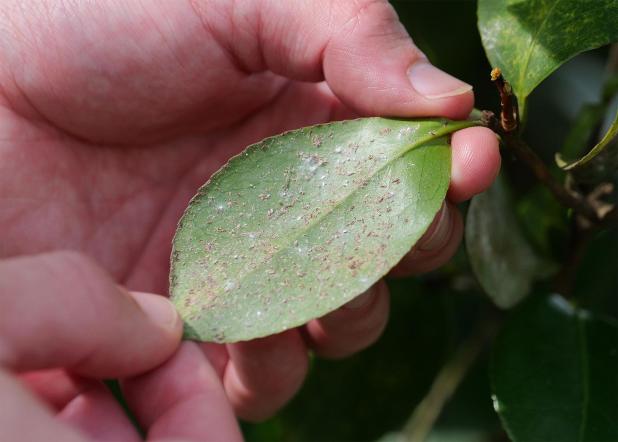
To figure out whether a camellia is suffering from a scale infestation, flip over a discolored leaf. Scales live in aggregations — or large groups — underneath foliage, where they leave behind a white, cottony residue.
“They are trying to hide from the light, heat and airflow because they are susceptible to desiccation,” said LSU AgCenter entomologist Aaron Ashbrook. “That’s something we actually can use for their management.”
Ashbrook recommends four methods for taming scale infestations. Each is best done at a particular time of year.
Option 1: Pruning
Camellias have dense foliage that offers plenty of protected hiding spots for scales. By pruning excess growth, you can increase airflow.
Not only does pruning discourage scales from taking up residence. It also makes it easier to get even coverage if you decide to treat the plant with insecticides or other products, Ashbrook said.
The best time to prune camellias is after they finish blooming in late winter. This is because camellias will be setting buds for next year’s flowers later in the year. Some selective pruning to open up the shrub for insect control is acceptable right now — just understand that you might reduce next year’s flower volume on the branches you prune.
Option 2: Systemic insecticides
You can apply a systemic insecticide such as dinotefuran during summer or any time that plants are not in bloom.
“This should be applied every seven to 10 days because the product does break down quickly,” Ashbrook said.
Systemic insecticides are applied to the root zone and absorbed by the plant, making its juices deadly to feeding scales and other insects. It is important to make these applications before flowering to protect pollinators.
Option 3:
Horticultural oils
Horticultural oils can provide non-chemical control of many insects, including scales.
“What’s important is that the application is done underneath the leaves to access the insects,” Ashbrook said.
“Also, the temperature is really important for that application. You want to use oils when it’s less than 85 degrees Fahrenheit outside or else you might damage the plants.”
So, file this information away for use in the cooler months.
Option 4: Contact
insecticides
Between March and May, scales are in their crawler stage of life.
These young, mobile insects can be controlled with contact insecticides such as acephate and malathion applied to the undersides of leaves, Ashbrook said. When using insecticides, be sure to follow all label directions and wear appropriate personal protective equipment.