
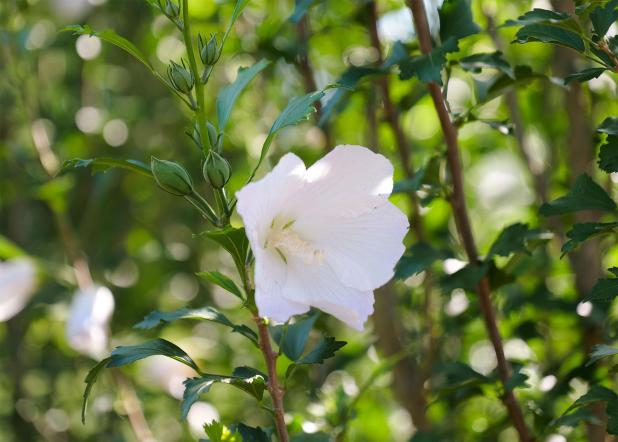
LSU AgCenter/Olivia McClure
Althea blooms are attractive to pollinators and last throughout summer.
Get It Growing: Althea is an old favorite worth remembering
Whether a song, a movie, a family recipe or a pair of broken-in blue jeans, old favorites are hard to beat. New things come along and distract us from these dependable standbys — but somehow, we always find our way back to their familiar comfort.
In the garden, an old favorite that’s worth revisiting is althea (Hibiscus syriacus), which you may know as rose of Sharon.
This flowering shrub, a native of Asia, was brought to the American colonies in the 1700s. It gained popularity quickly, becoming a bestseller in early nursery catalogs and remaining a landscape staple well into the 20th century. This was especially true in the South, where gardeners prized its ability to bloom profusely even in the heat of summer.
Unlike many of the 300-plus Hibiscus species grown around the world, althea is not tropical. It’s a temperate, deciduous shrub that handles both our intense summers and typical winters with grace.
Althea naturally grows as a multitrunked shrub, although some people train it to be a single-trunked tree. It works well as a specimen plant or a hedge. It reaches 8 to 10 feet tall, sometimes more, and up to 6 feet wide.
Pollinators love althea’s pretty flowers, which bloom from May until August or early September. In true Hibiscus fashion, the flowers are short-lived, lasting just a day or two. But new buds appear throughout the summer.
Different cultivars offer single blooms as well as semidouble and double forms that have a ruffled appearance.
Colors range from white, pink and purple to red and even bluish tones, sometimes with pink or red veins and throats. Small, toothed leaves provide a dark green contrast during the growing season before falling in the cooler months.
Traditional althea varieties readily self-seed and can spread like weeds.
But modern cultivars are sterile, meaning they don’t produce seed.
One such cultivar is Aphrodite, a product of the U.S. Department of Agriculture’s althea breeding program from the 1970s and ’80s. A 1988 release, Aphrodite — with its pink petals and red throat — was one of the LSU AgCenter’s first Louisiana Super Plant selections.
Another cultivar of note is White Pillar, a newer cultivar with bright white flowers and a tall, columnar shape that is an excellent fit for tight spaces.
Although althea is blooming now, it’s best to wait until fall or winter dormancy to plant. Choose a well-drained location — althea doesn’t like wet feet — with plenty of sun. You’ll get the most blooms in full sun, but part-sun conditions are OK.
Althea has few insect pest or disease problems, and it doesn’t require a lot of maintenance. Most plants stay in an attractive, vase-like shape on their own. If you decide to prune, do so in late winter or early spring — which also is a good time to put down an application of fertilizer.